Product Notes
When the Decision Score Stays Quiet: Confidence and Thin Data
The most trustworthy thing a Decision Score does is stay quiet when it hasn't got enough to say. Here is how to read a low-confidence or muted score — and why that restraint is the feature, not a gap.


Most of what I get asked about the Decision Score is how it produces a confident answer. The question I find more interesting is the opposite one: what happens when it shouldn't?
Because that case is common. A player who has only played a handful of matches this season. An event so new it has almost no history to read. A surface the player has barely stepped onto. In all of those, the honest amount to say is not much yet — and the most trustworthy thing the score does is admit it, out loud, instead of inventing a crisp-looking number on top of nothing.
This article is about the quiet version of the score. The muted verdict, the wider range, the confidence note that reads low. I want to explain why those show up, how to read them, and why the restraint is deliberate — a feature we built on purpose, not a gap we forgot to fill.
Where the data actually gets thin
"Thin data" sounds abstract. In practice it arrives in three very ordinary ways, and it helps to name them, because how you respond depends on which one you are looking at.
- The player is new, or newly back. A junior at the start of their circuit, or one returning from months out with an injury, simply has not generated much recent evidence. Form and momentum are read from matches that happened. If only six of them happened, the read is a rumour with a decimal point, and it should be labelled as one.
- The event has little history. A first- or second-year tournament, or one that recently changed grade, has barely any acceptance history to learn from. We cannot tell you how heavily it sheds withdrawals or where its cut line usually lands, because it hasn't done the thing enough times yet.
- The surface is unfamiliar. A player with forty hard-court results and four on clay does not have a clay record — they have an anecdote. A surface win rate built on four matches will happily print a number, and that number will be almost meaningless.
None of these is a flaw in the player or the event. They are just states of the world where the evidence is genuinely sparse. The mistake would be to pretend otherwise.
The problem is never that the data is thin. The problem is a tool that hides how thin it is.
What "staying quiet" looks like on screen
When the inputs get sparse, the score does one of three things, in rough order of how thin things are.
First, it lowers its confidence. Every estimate the score derives — entry chance, points opportunity, the match-level analytics behind a player's form — carries a confidence level, and often a coverage line alongside it: something like low confidence · 22% of matches rated. That second half is the tell. It is the model saying how much of the picture it can actually see, not just how it feels about the part it can.
Second, it widens the range. Where we forecast, we forecast in ranges rather than single points, and a thin input pushes those ranges open. An entry-chance estimate that would read Est. 60–70% on a well-documented event might read Est. 40–75% on a brand-new one. The width is not laziness. It is the estimate telling you honestly how much room the uncertainty occupies.
Third, when things are thin enough, it holds back the firm verdict altogether — muting a specific figure, or softening the plain-language line from a confident call to something closer to not enough to say yet. A blank where a bold number could have gone always looks less impressive. It is also more truthful.
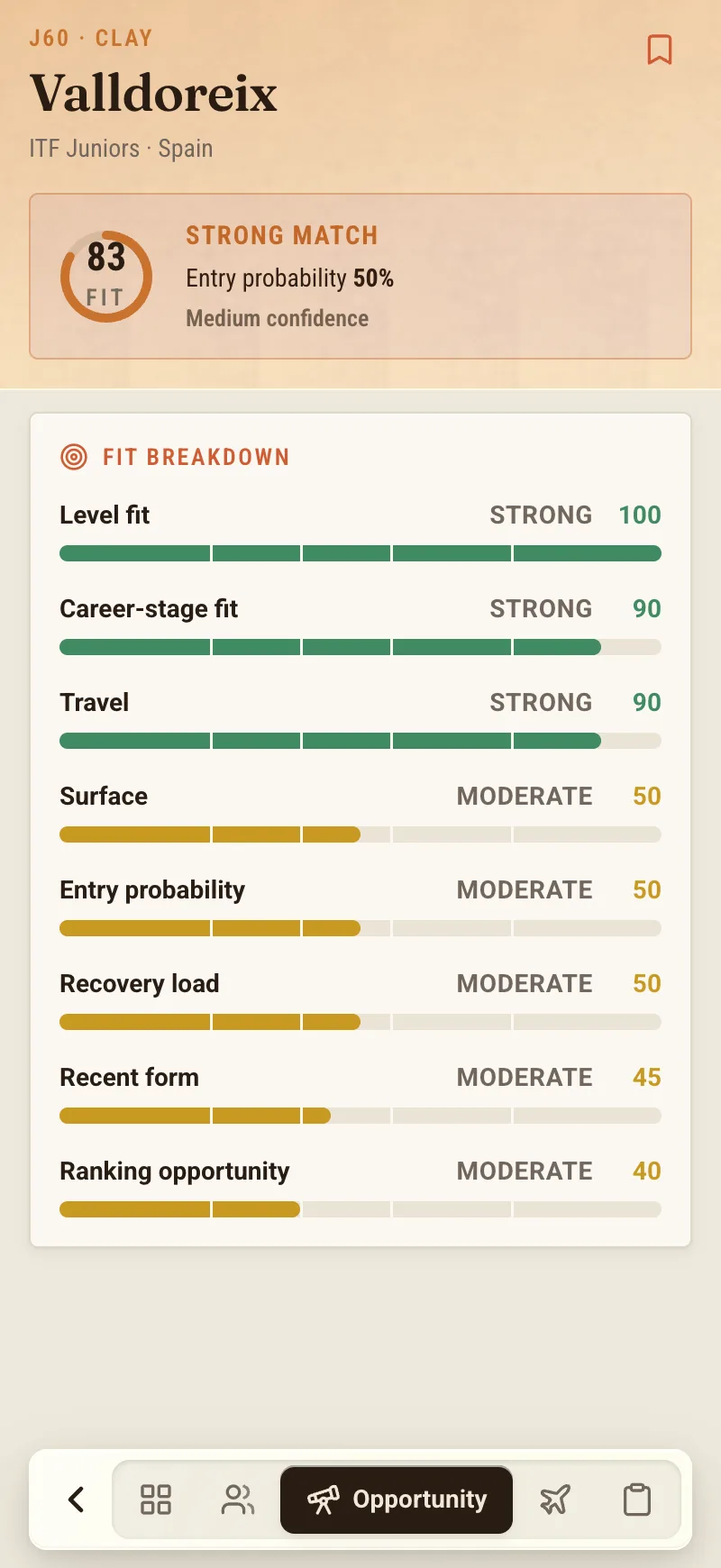
You can see all three moves at work above: the range is open, the confidence sits low, and the verdict declines to pretend. That is the score behaving exactly as designed.
Why a false decimal is worse than "not sure yet"
Here is the belief underneath all of this. A precise-looking number that the data does not support is not a smaller version of the truth. It is a different and worse thing than an honest shrug.
A confident 71% on four clay matches does real damage, because it ends the conversation. It looks settled. It invites you to book the flights, weigh it against your other events, treat it as known. And it was never known — it was noise wearing a suit. When it turns out wrong, you don't just lose the guess; you lose a little trust in every number the tool ever shows you, including the ones that were solid.
An honest not sure yet, by contrast, keeps the conversation open. It tells you exactly where to point your attention next. It costs you the momentary satisfaction of a bold figure and gives you back something more useful: an accurate sense of what you actually know.
A number you can't trust is worse than no number, because it forecloses the very judgement it was supposed to inform.
We would rather show you less and be trusted than show you more and be wrong. That trade is the whole design.
How to read a low-confidence or muted score
A quiet score is not a dead end. It is an instruction — just a different one from a confident score. Three ways to act on it.
Gather more signal before you lean on it. Low confidence driven by a small sample usually fixes itself with time and matches. If the read is thin because the player has only a few results this block, the honest move is to wait for a couple more events before trusting the form and momentum lines, rather than over-reading the ones you have. The number will earn its confidence as the evidence accumulates.
Lean on the factors that are well-covered. A Decision Score is never one input; it is several, each with its own confidence. When the surface read is thin, the entry-chance and schedule-load factors may still be perfectly solid. Read those, note that the surface line is uncertain, and weight accordingly. A low overall confidence rarely means everything is unknown — it means something load-bearing is, and the coverage lines tell you which.
Don't over-trust a thin number just because it rounded nicely. This is the discipline that is hardest to hold at 11pm before a deadline. A figure that happens to look clean is not more reliable for it. If the confidence note says low and the coverage says a fifth of matches rated, treat the figure as a placeholder, not a verdict — and take it to a coach as a question rather than an answer.
If you want the fuller picture of what feeds a score in the first place — which inputs, and how each one's certainty is tracked — I go through it in the inputs behind your Decision Score. And for the specific case of a muted entry-chance read, how NextPoint estimates entry chance — honestly walks through why a hidden percentage is itself a signal worth reading.
Why the restraint is the feature
It would be easy to read all of this as an apology — as though the quiet score were the product falling short and promising to do better. It isn't, and I want to be plain about that.
The bold number is the commodity. Anyone can print a confident figure; the hard part is knowing when not to. A tool that always answers, no matter how little it knows, is not more capable — it is just less honest, and you find that out at the worst possible moment. Restraint under thin data is the thing that makes the confident readings worth believing. A score that goes quiet when it should is a score you can trust when it speaks up.
That discipline runs through everything we build. Estimates are labelled as estimates, with a confidence level attached. Where we forecast, we forecast in ranges. And where the data cannot support a responsible answer, the product says so rather than manufacture one. It is worth adding, since it comes up: ITF and Tennis Europe results are the data sources we read from — they are not partners vouching for our maths, and NextPoint does not enter you into events or pay your fees. What the score offers is a well-labelled read on a decision, honest about its own limits, and never a guarantee of acceptance or of results.
NextPoint is in early access while we get exactly these details right — including the unglamorous work of deciding when the right output is a widened range or a blank space. If you'd like your child's real ranking, results, and entry lists turned into estimates that are candid about what they don't yet know, you can join the waitlist. A tool that is willing to stay quiet is, in the end, the only kind worth listening to.
About the author
Sofia Lindqvist is a sports scientist at NextPoint, where she works on player analytics and forecasting. She spends most of her time on the unglamorous question of when an estimate is honest enough to show — and when the right answer is to widen the range or say nothing at all. Her rule of thumb: a false decimal costs more than an honest shrug.