Product Notes
The Inputs Behind Your Decision Score
A Decision Score is one number out of 100, but it is built from several honest, tennis-specific signals. Here is what those signals are — and why we show them instead of hiding them.


A single number is easy to distrust, and it should be. When a tool hands you a Decision Score of 71 for a tournament, the reasonable first reaction is not "great, we'll go" — it is "71 out of what, exactly, and made of what?"
That is the right question, and this article is my attempt to answer it properly. Not with a formula, and not with a table of weights, but with an honest account of the kinds of things the score reasons over. Because the useful part of a Decision Score was never the number. It is the set of considerations underneath it, laid out so a player and coach can see what the number is actually made of.
I've written before about what a Decision Score measures at a high level, and separately about how the entry-chance estimate works in detail. This piece sits between them. It walks through the signals — the inputs — and, just as importantly, why we chose to show them rather than bury them.
Why inputs, not a formula
Let me be clear about one thing up front, because it shapes everything else. What follows is a description of the considerations that go into a score. It is not a published weighting, and it is deliberately not a recipe.
There is a good reason for that, and it is not secrecy for its own sake. A score you can reverse-engineer is a score you can game. If we told you that surface fit was worth exactly this many points and travel exactly that many, the incentive would quietly shift from making a good decision to maximising a number. And the moment a player is optimising the metric instead of the outcome, the metric has stopped measuring anything real. Every honest ranking system in the world runs into this, and the honest ones respond the same way: describe the inputs clearly, keep the exact arithmetic out of reach.
So think of the Decision Score less as a calculator and more as a structured second opinion. It considers the things an experienced coach would consider, in a consistent order, without forgetting the boring ones. It just doesn't hand you the dials to spin.
The signals it reasons over
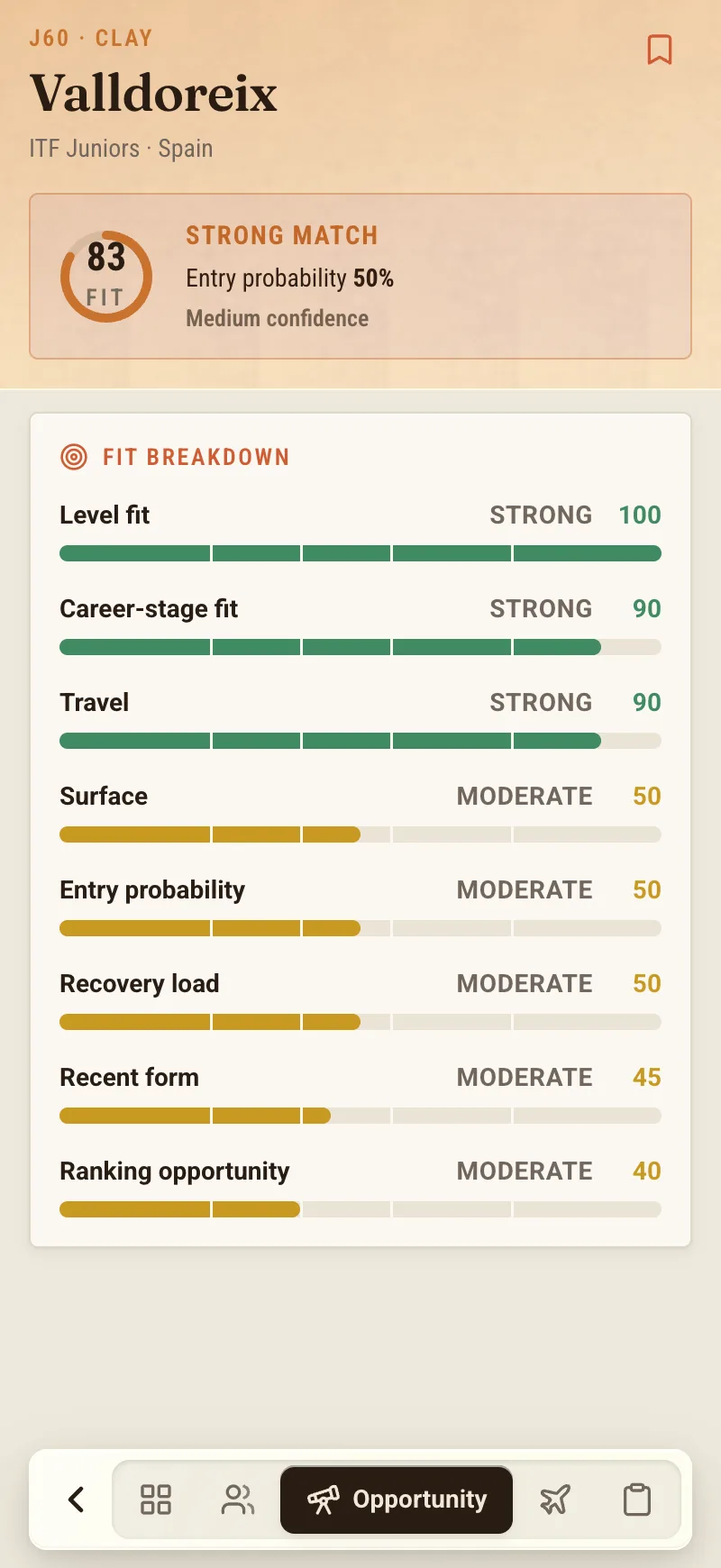
Here are the kinds of inputs that shape a Decision Score. I'll describe each one qualitatively, because that is genuinely how they work — none of them is a fixed number of points, and several of them interact in ways a flat weighting could never capture.
Surface fit. Clay and hard are not the same sport, and most players' records say so plainly. A player who grinds out three-set wins on clay and loses early on quick hard courts is telling you something real about where their game travels. So the score looks at the player's record on the surface the event is actually played on, rather than treating all wins as interchangeable. It is one of the more legible signals — a player's own results are hard to argue with — and it often does more quiet work than people expect.
Grade and level fit. Every event sits at a level — the ITF Junior grades from J30 up through J300, or the Tennis Europe categories — and the question is whether this event, at this grade, suits where the player is right now. Not where they'd like to be by the end of the season; where they are this month. An event that is a rung too high can be a valuable stretch or a demoralising first-round exit, and an event a rung too low can be points in the bank or a week better spent elsewhere. The score weighs the match between the player's current level and the event's demand.
Entry chance. There is no point scoring a tournament highly on every other axis if the player realistically won't get into the draw. So the score folds in an estimate of acceptance — where the player's list position sits against the current entry list, the draw size, and the event's history of withdrawals. I want to be careful here: this is an estimate, always labelled as one, and it is a range with a confidence level rather than a bare percentage. It is genuinely uncertain, for reasons of moving rankings and last-minute withdrawals that I've laid out at length in the entry-chance article. It never claims the player will get in. It just refuses to recommend an event the player probably can't play.
Points on offer versus what's realistic. A big event dangles a lot of ranking points, but the headline figure is the number you'd get by winning the whole thing, which very few players will. The more useful reading is what a realistic run at this event — given the player's level and the strength of the field — could actually be worth. A modest event the player can genuinely go deep in sometimes offers more real points than a glamorous one where the likely outcome is a first-round loss. The score tries to reason about the plausible return, not the advertised ceiling.
Travel and cost context. This is the input gut decisions forget most often, and it matters more over a season than any single result. Flights, nights in a hotel, days out of school, the sheer friction of getting there — these are real constraints on a junior's calendar and a family's budget. The score keeps them on the table so that a tournament which looks great on paper but requires crossing a continent for a 32-draw gets read in that light. It is not the biggest signal, but it is the one people are most grateful to be reminded of.
Recent form and load. Finally, the score considers how the player has actually been playing lately, and whether they've been playing too much. Our analytics summarise a player's state through a small set of six signals — things like form, momentum, and surface performance — and the relevant ones feed in here. Just as importantly, schedule load: if this event stacks onto an already heavy block of consecutive weeks, that counts against it, because a tired player at week five is not the same competitor as a fresh one at week one. Form tells you how they're playing; load tells you whether they can keep it up.
Those are the considerations. Notice what they have in common: every one is a thing an experienced coach already weighs, just scattered across different websites and half-finished mental estimates. The score's job is to gather them and reason over them the same careful way each time, so the boring inputs don't get dropped the night before a deadline.
Where the inputs come from
A signal is only as good as the data under it, so it's worth saying where these come from. Acceptance and results sync from the player's ITF or Tennis Europe profile, which means the form, surface record, and entry-list inputs reflect what actually happened on court rather than what someone typed in by hand.
I'll say this once and plainly, because it matters: ITF and Tennis Europe are the data sources we read from. They are not partners, and they do not vouch for our maths. NextPoint does not enter you into any tournament, does not pay your fees, and is not part of any federation's entry system. We read the public record of results and entry lists; the reasoning on top of that record is ours, and the score is never presented as anyone's official word.
Why the score shows its reasons
Here is the design choice I'm most attached to. The Decision Score does not just print a number and stop. It shows the inputs — the reasons the number landed where it did — right alongside it.
That sounds obvious until you notice how many tools don't. A bare score is authoritative and useless in equal measure. You can't sanity-check it, you can't push back on it, and you can't bring it to a coach who knows something the model doesn't — that this particular event always sheds a dozen withdrawals in the last week, or that the player has been quietly nursing a wrist. A number with no reasons underneath it ends the conversation. A number with its reasons starts one.
So when the score is lower than you expected, you can see whether that's surface fit or entry chance or an already-crowded schedule dragging it down — and you can decide whether you agree. The reasons are handles. They let a coach nod and say "yes, but," and adjust the read with knowledge no model has. That is the entire point. The score is not trying to be right in a vacuum; it is trying to be specific enough to argue with.
What the score is honest about not knowing
The same honesty that makes us show the inputs also makes us admit when they're thin. When the data behind a signal is sparse — too few matches on a surface to read a real pattern, an entry list too empty to say anything responsible about acceptance — the confidence drops, and where a number would be misleading, the product widens the range or holds it back rather than printing a confident-looking figure on top of not much. I've written about that discipline in detail in the entry-chance piece, so I won't repeat it all here. The short version: a Decision Score is an estimate, never a guarantee, and a signal we can't read honestly is one we'd rather label as uncertain than fake.
The point of all of it
A Decision Score is one number out of 100, but it was never meant to be just a number. It is a compression of several real, tennis-specific considerations — surface, level, entry chance, realistic points, travel, form and load — into something a player and coach can talk through in two minutes instead of twenty. The number gives you a quick read. The inputs underneath tell you whether to trust it.
It is a structured second opinion, not a verdict from above and not a formula to optimise. The player still chooses, the coach still coaches. The score just makes sure the decisive, easily-forgotten details are on the table, each with an honest label on how sure we are.
NextPoint is in early access while we get details like this right. If you'd like your child's real rankings and entry lists turned into a score that shows its reasons — and is honest about what it can't see — you can join the waitlist. We would rather show you less and be trusted than show you more and be wrong.
About the author
Sofia Lindqvist is a sports scientist at NextPoint, where she works on player analytics and forecasting. She spends most of her time on the unglamorous question of when a signal is honest enough to show, and how to describe an input without turning it into a number people try to game.