Product Notes
What Explore Covers — and What It Doesn't
Explore surfaces ITF Juniors and Tennis Europe events with fact sheets, filters and honest estimates. Here is exactly what it covers — and the national circuits, portals and partnerships it deliberately does not.


A tool is defined as much by what it refuses to do as by what it does. That is easy to say and awkward to publish, because the honest version of a coverage page is shorter and less flattering than the marketing version. But a parent planning a season deserves to know the edges of the map before they rely on it — where the data is good, and where it simply stops.
So this is the plain account of Explore: the part of NextPoint where new junior tournaments surface each week. What it reads, what it shows, and — the part I care most about getting right — the things it does not touch. If you want the walkthrough of how to actually use it to find events, that lives in what Explore does: finding tournaments. This piece is narrower and more honest about limits: it is the boundary line, drawn clearly.
What Explore covers
Explore covers two competitive circuits, and it is worth being precise about which two.
The first is the ITF World Tennis Tour Juniors — the worldwide under-18 circuit, from the J30 entry rungs up through J500 and the Junior Grand Slams. The second is Tennis Europe, the junior tour that most European players live on before ITF, across the 14 & Under and 16 & Under age groups. Those two together are the spine of a serious European junior's competitive calendar, and they are what Explore is built to read.
There is a third thing on the screen, and it needs an asterisk that I want to make loud rather than quiet. ATP and WTA events are shown for reference only. They are there so a family can see the professional tournaments in the same weeks and places — useful context, occasionally a reason to travel, sometimes just orientation. They are not the point of the product, and Explore is not a professional-tour planning tool wearing a junior costume. It reads them so you can see them; it does not pretend a junior is entering them.
Within that coverage, here is what Explore actually does with the events it reads:
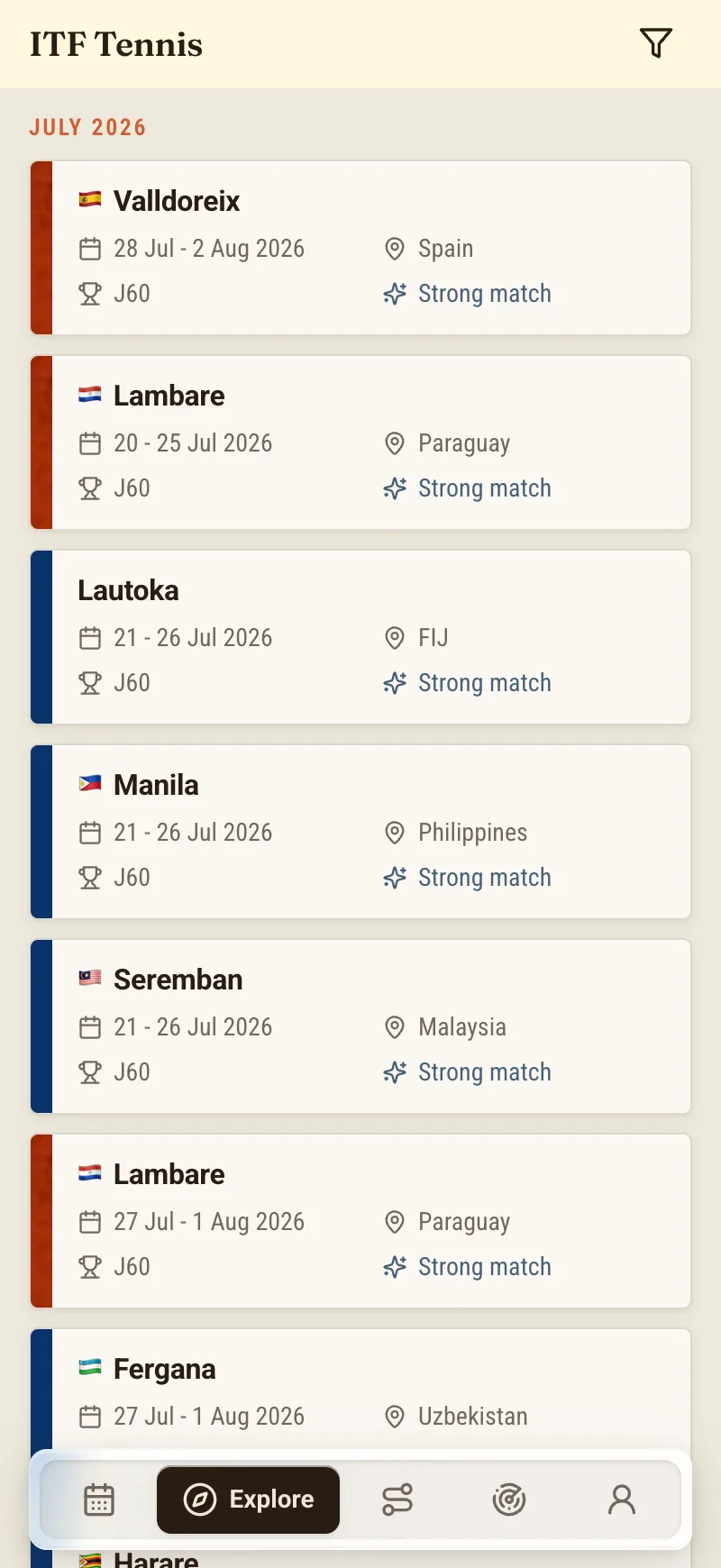
- It surfaces new events weekly. As tournaments appear on the ITF and Tennis Europe calendars, Explore brings them forward so you are looking at what is genuinely open, not a stale list you have to cross-check by hand.
- It gives each event a fact sheet. Grade or category, dates, location, surface, draw size, entry deadline — the facts you would otherwise assemble from several tabs, gathered in one place.
- It lets you filter. By grade, by region, by surface, by the weeks you can actually travel — so the calendar narrows to events that could plausibly fit a real family's constraints instead of every event on earth.
- It attaches a Decision Score. A single read of a specific event in context — the player's ranking against the field, the grade, the surface, the cost of getting there — meant to turn a wall of tournaments into a small number of considered options.
- It shows an entry-chance estimate. Not a promise. A labelled Est. range with a confidence level, because acceptance is a moving target and anything that prints a bare percentage is selling a certainty it has not earned. The full reasoning behind that choice is in how NextPoint estimates entry chance.
One clarification while we are here, because it comes up: the Decision Score is a decision aid, a way of reading one event in context. It is not a "fit score," and I would rather retire that phrase than have anyone read it as a compatibility rating that guarantees an event suits a player. On surface, for instance, it frames the honest distinction most juniors care about — clay versus hard — rather than implying it has solved something subtler than it has. It is context, offered to inform a call you still make.
What Explore does not cover
Now the part that matters more than any feature list: the edges.
Explore does not cover national-federation circuits. The USTA's domestic tournaments, the FFT's French circuit, the LTA, the RFET, the DTB — the national tours that most juniors actually start on and play the most of — are not in Explore. This is not an oversight we are quietly hoping you will not notice; it is a scope decision. Explore reads two international circuits well rather than reading twenty national ones badly, and I would rather tell you the boundary than blur it.
NextPoint shows no national ranking lists. There is no USTA ranking table here, no LTA standings, no national points list of any kind. National rankings are federation-specific, they are the earliest number that matters for most juniors, and they often govern entry into the very Tennis Europe and ITF events Explore does read — but NextPoint does not host or reproduce them. If you are trying to work out how your national number relates to the international one, that is a real and common question, and it has its own guide: national ranking or ITF ranking — which one matters when. Explore is simply not the place that number lives.
I want to be candid about what this means in practice. If your child is eleven and playing mostly domestic events, Explore will feel thin, and it should — it is not built for that stage yet. It comes into its own as a player moves toward Tennis Europe and then ITF. Telling you that now is more useful than letting you discover it after you have relied on it.
What Explore does not do
Coverage is one boundary. Action is another, and it is the one most likely to cause real harm if it is misunderstood.
Explore does not enter, pay for, or withdraw a player from anything. It is a discovery and decision-support surface — it helps you decide whether an event is worth entering. The entering itself happens where it has always happened: on the federation's own portal, the official system your national body and the ITF or Tennis Europe run. When the deadline matters, that portal is the source of truth, not us.
This distinction is not a limitation I am apologising for; it is a safety boundary I want stated plainly. A tool that quietly implied it had entered you — and had not — would be dangerous the night before a freeze. So Explore stays firmly on its side of the line: it reads the calendar, it helps you think, and it hands you back to the official portal to actually commit. If a spot is booked, a fee is paid, or a withdrawal is filed, you did it on the federation's system, and that is by design.
What Explore is not affiliated with
The last boundary is the one about relationships, and it underwrites everything above.
Explore is not affiliated with, partnered with, or endorsed by the ITF or Tennis Europe. They are data sources — public circuits whose calendars and results NextPoint reads from — and nothing more than that. They do not vouch for our Decision Score, they have not blessed our entry-chance estimates, and reading their data does not make us their agent. When Explore shows you a J300 in the right week, that is us reading a source and organising it for you; it is not the ITF speaking through our interface.
The same holds for the professional events shown for reference: reading the ATP and WTA calendars does not imply any tie to those tours either. And where NextPoint reflects third-party ratings elsewhere in the product, like WTN or UTR, those remain their owners' systems, unchanged by us reading them.
I labour this because affiliation is exactly the kind of thing a product is tempted to imply and never quite state — a logo here, a "powered by" there, until a reader assumes an endorsement that was never given. I would rather draw the line myself, in words: data sources, not partners.
Why the limits are the point
It would be easy to write a coverage page that lists the two circuits, the fact sheets, the filters and the score, and stops there — the flattering half. But a family plans real weeks and real money around this, and the useful version of a coverage page is the one that also says: not national circuits, no national rankings, we do not enter you, and no federation is standing behind these numbers. Those four sentences are not the fine print. On a decision that costs flights and school days, they are the part worth reading twice.
NextPoint is in early access while we get boundaries like these drawn cleanly rather than blurred. If a discovery tool that is honest about its own edges — ITF Juniors and Tennis Europe, read well, with estimates that never pretend to be guarantees — is the kind of thing that would help, you can join the waitlist. We would rather tell you where the map ends than paint over it.
About the author
Sofia Lindqvist is a sports scientist at NextPoint, where she works on player analytics and forecasting. She spends most of her time on the unglamorous discipline of marking a tool's edges honestly — what the data covers, what it does not, and where a confident-looking answer would be a quiet overreach.