Product Notes
Watching Players and Rivals: When Someone Enters Your Draw
Keep a watchlist of the players you care about, and Radar tells you when one of them enters an event you're eyeing. It's a quieter kind of scouting: knowing who's in the room before you commit to the week.


There is a small, specific dread I remember from the circuit, and it always arrived at the same moment. You walk into the club on the morning of qualifying, you pin your name to the board, and you glance at the list beside it. And there, three lines down, is a name you know. The player who beat you in three last month. Or the one everyone's been talking about all season. You didn't know they were coming. Now you do, and the draw is already made, and there is nothing to do about it but play.
That feeling is not information. It's a surprise, and surprise is the enemy of a calm week.
The thing is, that name didn't appear that morning. It had been on the entry list for days — public, sitting there, visible to anyone who thought to look. You just didn't look, because who has the time to check every list for every player they half-remember? So the knowledge that could have shaped the whole week — whether to enter, whether to expect a hard draw, whether to plan around it — arrives too late to be worth anything.
Radar's watchlist exists to move that moment earlier. Days earlier. Back to when it's still a decision instead of a fact.
A list of the people you actually track
Here's the plain version. In Radar, you can keep a watchlist of players. Rivals. Players around your junior's level. Someone whose results you follow for no reason other than that they're a useful yardstick. You put them on the list, and Radar watches the entry data on your behalf.
When one of those players enters an event — an event you're considering, or one already sitting on your plan — Radar tells you. Not with a fanfare. Just a quiet heads-up: this player you follow has entered here.
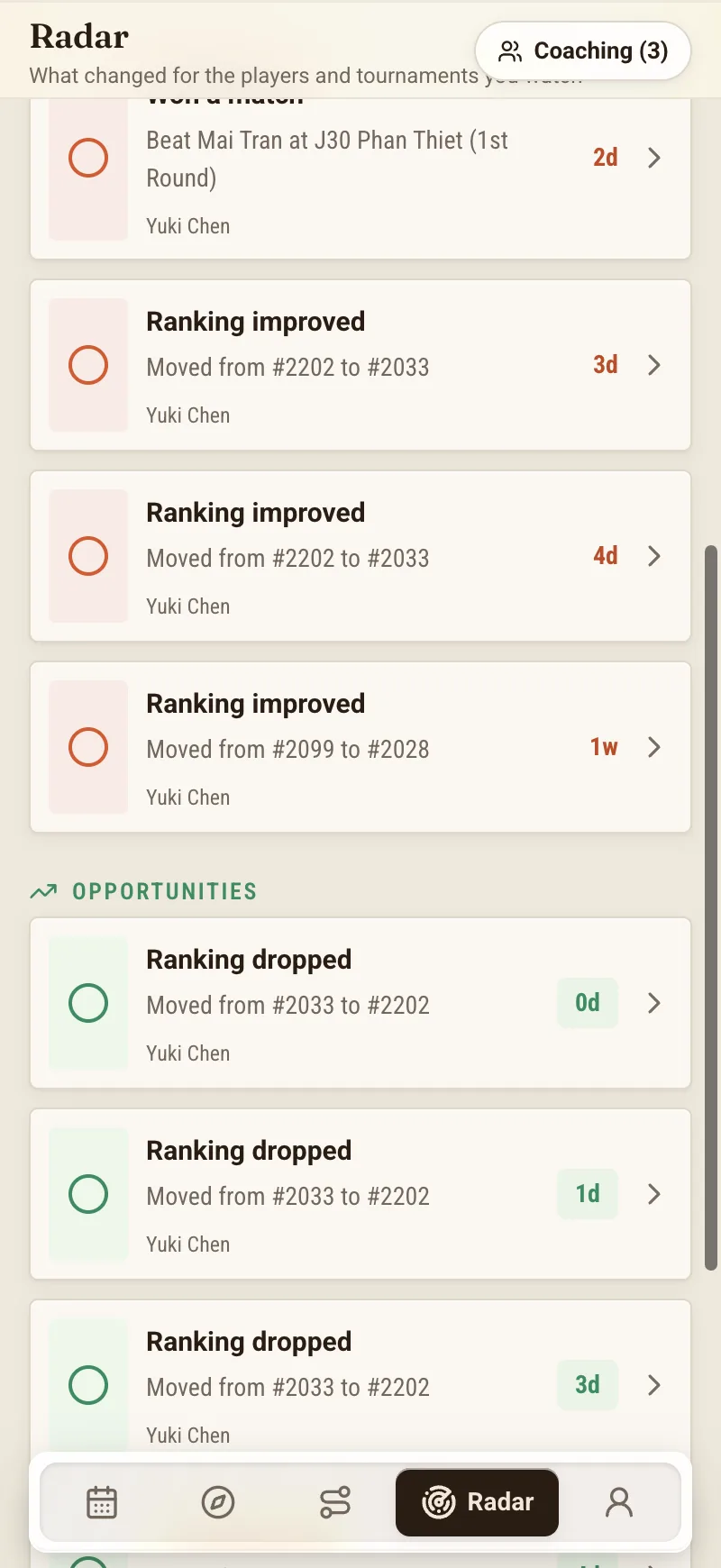
That's the whole mechanic, and its usefulness is easy to underrate until you've missed a name on a board. A watchlist turns "who's playing this week?" from a research project into something that simply arrives. You're not refreshing federation pages at midnight or scrolling entry lists hoping to recognise a name. You've told Radar who matters. It does the watching.
None of this is exotic data. It reflects the public entry lists on the junior circuit, read from ITF and Tennis Europe as data sources, not as affiliations or endorsements. Who has entered what is a matter of record, published openly. Radar just reads that record with your list of names in hand, so the ones you care about surface instead of hiding in a wall of entries.
What it changes about the decision
A watchlist earns its place in three ordinary situations, and I've been on the wrong side of all of them.
It flags a tough draw before you commit. This is the big one. You're weighing an event — decent points, reasonable travel, a list position that looks live. Then Radar mentions that two of the players you watch, both of whom sit clearly above your junior, have entered the same event. That doesn't make the decision for you. But it changes the shape of it. Maybe you enter anyway, eyes open, treating it as a measuring week. Maybe there's a thinner event the same swing that suits better. Either way, you chose it. You weren't ambushed by it on the morning board.
It shows you where a rival is playing. Junior tennis is a small world stretched across a big map, and the players near your level tend to move in loose orbits — chasing the same points, the same surfaces, the same forgiving draws. Knowing that a genuine rival has entered an event tells you something real about the week ahead, and sometimes it's a reason to be there rather than a reason to stay away. A rematch on your terms, with time to prepare, is worth a great deal more than one you stumble into.
It helps you read the week. Sometimes the value isn't about any single player. It's the pattern. When four names off your watchlist all cluster into one event, that event is telling you something — it's where the level is going that week. When they scatter, that's information too. You start to see the circuit's currents instead of just your own lane.
In every case the point is the same. You're making the call while it's still a call, with the names in front of you, instead of reacting after the draw is set.
What this is not, said plainly
I want to be careful here, because a feature that watches players could be described in a way that sounds like something it isn't. So let me draw the line hard.
This is entry and schedule awareness. It is not surveillance. Radar tells you that a player has entered a public tournament, the same fact printed on the acceptance list for everyone to see. It doesn't track anyone's movements, location, or anything about them beyond what they've publicly declared by signing up to play. Putting a rival on your watchlist is no more intrusive than reading the entry board at the club — it's the same information, delivered earlier and without the trip.
It is also not live scores. Radar does not follow a watched player's match in progress, does not tell you they're down a break in the second, does not ping you when they win. There's no real-time integration behind any of this, no live feed, no scoreboard. It reads entry lists, which change over days, not seconds. If you want to know how someone's match is going, this feature has nothing to offer you, by design.
Say what it does. Stay quiet about what it doesn't. A watchlist tells you who has entered where. That's the beginning and end of it.
The "how they play" question is a different tool
There's a natural next question once you know a rival has entered your event: not just that they're there, but how they've been playing. That's a fair thing to want, and NextPoint does have an answer for it — but it's a separate feature, and I want to keep the two from blurring together.
Player analytics on NextPoint describe how someone has been performing through six metrics, read entirely from results: momentum, form, closing, consistency, surface, and pressure. Whether a player's been winning lately, how their recent matches actually went, whether they convert winning positions or leak them, how steady they are week to week, how they do on this surface versus that one, and how they hold up in third sets and tiebreaks. Six honest readings of what the scoreboard recorded.
Notice what is not in that list. There is no shot-level data. Nothing about a forehand, a serve, a grip, a slice. No wearables, no sensors, no claim to have watched a single stroke. These metrics are built from match outcomes — who beat whom, on what surface, in which round — because outcomes are the things that actually moved a ranking. And none of it comes with a guarantee. A thin sample stays quiet rather than dressing up two matches as a strength. I wrote at length about reading those signals honestly, without flattering or frightening yourself, in Scouting an Opponent Without Overthinking It.
The clean way to hold it in your head: the watchlist answers who's in the draw. The analytics answer how they've been playing. The first is a scheduling awareness tool. The second is a preparation tool. They work well together, but they are not the same thing, and neither one pretends to be the other.
Who belongs on the list
A watchlist is only as useful as it is honest, so build it with a little discipline. Put on it the players who actually change your decisions. The rival you'll meet again. The two or three names just above your level who tell you where a draw's ceiling sits. The player whose season you track because it's a fair mirror of your own.
What you don't want is a list of fifty names you added on a whim, because then every heads-up is noise and you stop reading them. Keep it to the people whose entry into an event would genuinely make you think. That's the test. If a name entering somewhere wouldn't change a single thing you do, it doesn't need to be on the list.
Used that way, the watchlist becomes part of a quieter rhythm — the same one that lets Radar surface a moving alternate spot or a deadline before it ambushes you. If you want the wider picture of how Radar turns a scattered week into a single readable feed, I laid it out in Meet Radar: Your Daily Change Feed.
The point of knowing early
Everything about this feature comes back to one idea. The morning-board surprise — the rival three lines down, discovered too late — was never a tennis problem. It was an information problem, and information problems have solutions. A player who knows a week early that a tough draw is forming can choose their way through it. A player who finds out at sign-in can only endure it.
We're in early access. If you'd like the names that matter to surface before the draw is made — rivals, yardsticks, the players who shape your week — you can join the waitlist. Bring the surprise forward a few days. It's remarkable how much calmer the walk to the board becomes when there's nothing on it you didn't already know.
About the author
Daniel Okonkwo is a former touring professional who writes on life on the junior circuit at NextPoint. He lost more than one match to a name he'd have prepared for if he'd only seen it on the list a few days sooner. He'd rather you didn't.