Product Notes
The Deadline Countdown: 14, 7, 3, and 1 Days Out
Junior tennis deadlines cluster onto the same couple of days and pile up dozens deep. Radar counts them down at 14, 7, 3, and 1 days out, so the one that matters never arrives as a surprise.


The worst feeling in junior tennis has nothing to do with a scoreline. It is opening a fact sheet on a Wednesday morning, seeing the event your player was genuinely well placed for, and realising the entry deadline was yesterday. No match was lost. No opponent was better. A date slid past on a busy week, and the tournament is simply gone.
I have done this. Not once. I have a specific memory of standing in a supermarket car park, phone in hand, doing the maths on a deadline I had known about three weeks earlier and somehow let evaporate. My player was fine about it — juniors are always more forgiving than the parent — but I was not fine about it, because it was not a tennis mistake. It was a calendar mistake, and calendar mistakes are the ones that keep you up, because they were so completely avoidable.
This piece is about the small feature in NextPoint that exists so that particular morning stops happening. It is not clever. It is a countdown. But the reason it works is worth understanding, because it comes straight out of how junior deadlines actually behave.
Why one deadline is easy and twenty are not
If your player only ever entered one event at a time, you would not need any of this. You would remember. One date, held in your head, checked off, done.
That is not the season anyone actually has. A junior chasing a schedule across a swing has a shortlist of events, and each event carries not one deadline but several — the entry deadline, the withdrawal deadline, the on-site sign-in. So a modest shortlist of six or seven tournaments is really eighteen or twenty separate dates, each one mattering at a different moment, each one quietly ticking regardless of whether you are thinking about it.
And here is the part that turns a manageable list into a trap. Those dates do not spread themselves out politely across the calendar. They cluster. On the ITF and Tennis Europe circuits — and to be clear, those are the tournament feeds NextPoint reads as data sources, not affiliations or endorsements — entry deadlines bunch onto the same couple of days, overwhelmingly Tuesdays and Wednesdays, at roughly the same lead time before each event. Which means they do not arrive one at a time. They arrive in a heap.
I have seen a single day carry dozens of entry deadlines at once. Not spread across a fortnight where you might catch each one. All due together, on a Tuesday, while you are thinking about a school run and a physio appointment and absolutely not about a federation portal. If two or three of your shortlisted events happen to share that Tuesday — and because everything clusters, they very often do — you are being asked to make several decisions in the same distracted hour. That is exactly the hour a good one slips through.
What the countdown actually does
So the fix is not a single reminder. A single reminder on the day is the same trap wearing a hat — if you are busy that morning, you miss the reminder too. What you need is to see the thing coming from a distance, and then keep seeing it, more insistently, as it gets close.
That is the whole idea behind Radar's deadline countdown. As a deadline approaches — whether it is an entry deadline, a withdrawal deadline, or a sign-in — Radar escalates its reminders at roughly 14, 7, 3, and 1 days out. Two weeks ahead, you get the first quiet heads-up: this is on the horizon. A week out, again, a little firmer. Three days. Then the day before. The same deadline, surfaced four times, each one closer and harder to wave away than the last.
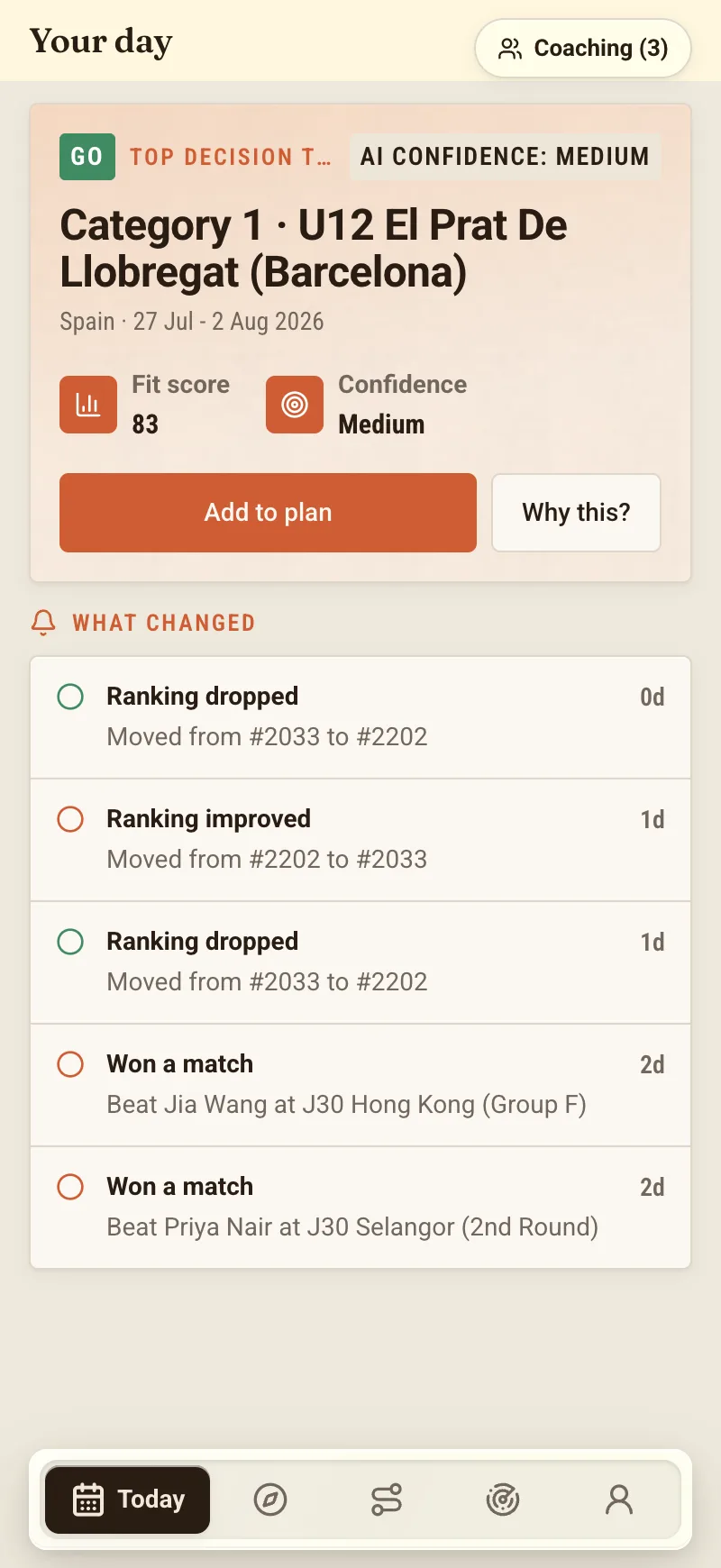
The escalation is the point. A two-weeks-out nudge is easy to acknowledge and set aside, and that is fine — that is what it is for. It plants the date. The one-day-out nudge is the one that catches you when the plant did not take, when life buried the earlier reminders under everything else. Between the two, and the two in the middle, a deadline has to get past you four separate times to actually go missing. That is a very different proposition from a date sitting silently in a PDF you read once, three weeks ago, and have not opened since.
What it changes, honestly, is not the work. You still have exactly the same decision to make and the same entry to complete. What it changes is the texture of the season. A pile of scattered dates that you carry as low-grade dread becomes a steady, repeating rhythm — fourteen, seven, three, one — that you learn to feel. The deadlines stop ambushing you. They start announcing themselves, calmly, in order, with enough runway to do something about them.
It can reach you where you actually are
The other thing worth saying plainly is that these reminders do not only live inside the app, waiting for you to remember to open it — which, on the exact busy weeks that matter most, you will not.
The countdown can push to your phone. So the three-days-out nudge for a withdrawal deadline finds you at the dinner table, not the next time you happen to think to check. This matters more than it sounds, because the whole failure mode we are trying to prevent is forgetting to look. A reminder that depends on you opening the thing you forgot about is not much of a reminder. One that arrives on its own, on the phone already in your pocket, is the version that actually works on a chaotic Tuesday.
What it is, and what it is not
I try to be honest in these write-ups about the edges of a feature, because a countdown you trust too much is worse than one you understand.
Radar is a daily digest and reminder — not a live, real-time integration. It reads the deadlines published on the ITF and Tennis Europe fact sheets and counts them down for you. It checks and surfaces changes on a daily rhythm; it is not a wire tapping the federation systems the instant something moves. For the purpose of a countdown measured in days, a daily cadence is exactly right. But treat the reminders as well-timed heads-ups, not as a live guarantee ticking to the second.
And the dates themselves can change. A deadline read from a fact sheet today can be amended by the organiser tomorrow — dates move, events get restructured, occasionally a fact sheet is simply corrected. Radar counts down the deadline it last read, which is why the countdown points you back to the source rather than replacing it. The official fact sheet is always the final word. If Radar says three days and the fact sheet says something else, the fact sheet wins, every time. Reading one properly is a skill worth having on its own, and I walked through it in how to read a tournament fact sheet.
Most importantly: NextPoint does not enter, withdraw, or pay for anything. The countdown reminds you that an entry deadline is coming. It does not enter your player. The withdrawal countdown reminds you that the free-withdrawal window is closing; it does not pull your player out. Every actual action — entering, withdrawing, paying the fee, signing in — still happens the way it always has, on the federation portal, by your hand. Radar surfaces the when. The doing stays entirely yours. I labour this because the instinct, late at night before a deadline, is to assume that an app which knows about a deadline must also be handling it. It is not. It is nudging you to handle it.
Why the countdown matters more than any single reminder
There is a bigger reason the deadlines deserve this much care, and it is not really about admin at all.
On this circuit, being on the list when it starts to move is most of the game. Fields shed a huge share of their entrants before play — most of a junior draw withdraws before a ball is struck — and the players who benefit from all that churn are simply the ones who were entered in time to ride it. I wrote about that pattern, and why a low list position is so often not the verdict it looks like, in the 60% rule. But every word of it assumes you made the entry deadline. Miss that, and none of the encouraging maths applies to you, because you are not in the calculation at all. The countdown is what keeps you in it.
That is the honest ambition of this small feature. It will not choose your tournaments, weigh your chances, or make a single decision for you — those belong to you and your coach. What it does is far narrower and, for a tennis family running on stolen ten-minute windows, worth a lot: it makes sure that the deadlines you already care about announce themselves early, repeat as they close, and reach the phone in your pocket, so the season stops being a set of dates that can ambush you and becomes a rhythm you can actually feel coming.
NextPoint is in early access. If you would like the deadlines to stop arriving as surprises, you can join the waitlist and we will be in touch.
About the author
Tom Vance is a junior coach and tennis parent who writes on the family side of competitive tennis for NextPoint. He has missed exactly one entry deadline that he still thinks about, and built a large part of his opinion about reminders around never doing it again.