Product Notes
Reading a Tournament Fact Sheet in NextPoint
Every event in Explore opens a fact sheet — deadlines, fees, surface, ball and draw format in one place. Here is how to read it before you commit, and why the deadlines matter most.


I have made the expensive mistake, so let me save you from it. A few seasons back I had a player whose whole autumn hinged on one event — the right grade, the right surface, a week that finally lined up with school. We talked about it for a fortnight. We planned the travel. And we missed the entry deadline by two days, because the deadline lived on a PDF I never quite got around to opening. There was no appeal, no exception, no kind email that fixed it. The week simply went to someone who read the sheet.
That is the thing about tournament entry: almost none of the ways it goes wrong are dramatic. They are small, quiet, administrative failures. A date not checked. A fee not budgeted. A surface nobody confirmed until the car was already packed. The tennis is the hard part your child trains for. The paperwork is the easy part that trips up the grown-ups, and it trips us up because the details are scattered and dull and never in one place when you need them.
That scattered feeling is exactly what a fact sheet is meant to fix.
What the fact sheet is
In NextPoint, every event you find in Explore opens a fact sheet — a single card that gathers the handful of details that actually decide whether you enter, and pulls them out of the PDF and into plain view. It is not marketing copy about the venue. It is the practical stuff: the three deadlines, the fees, the surface, the official ball, the draw format. The details that a good tournament parent ends up hunting for anyway, laid out where you can read them in one sitting.
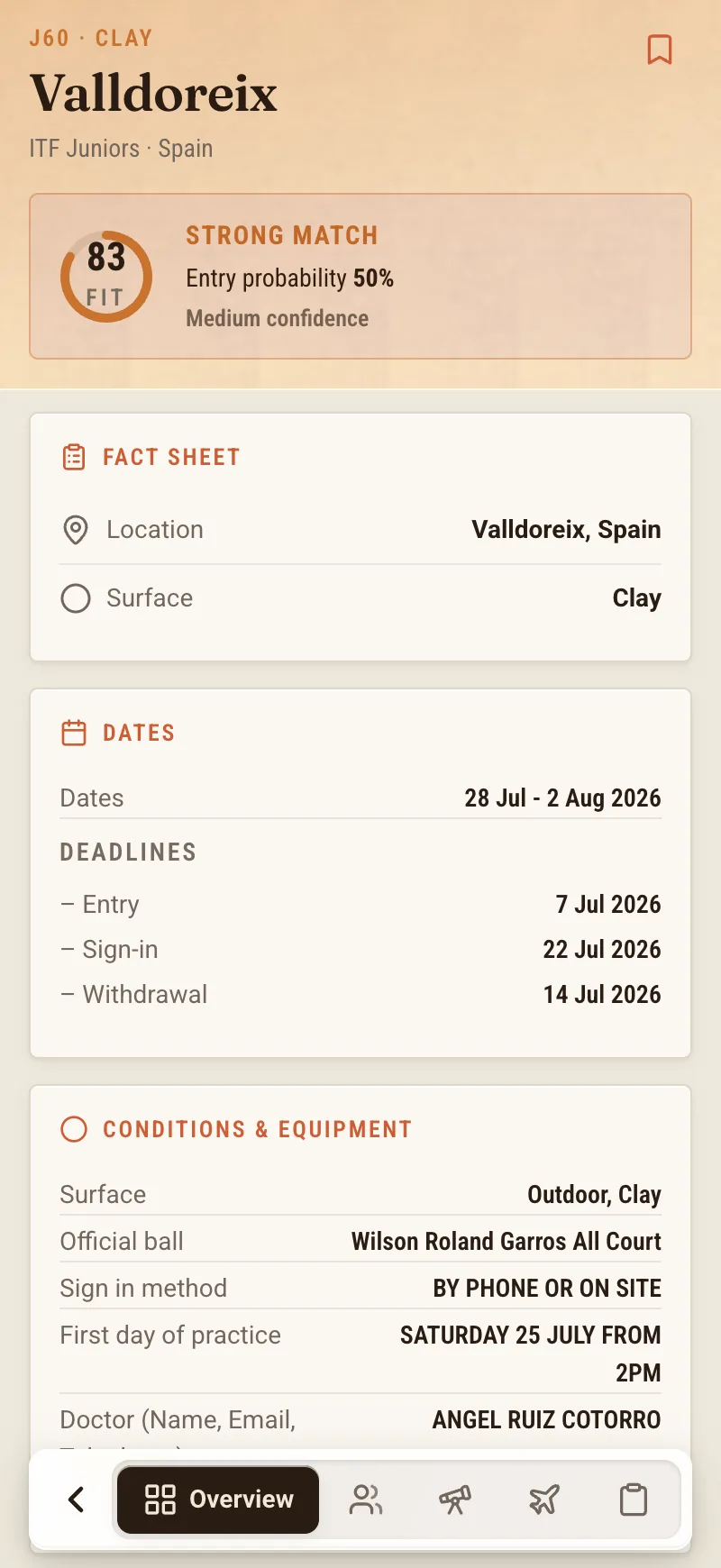
Before I walk through the pieces, the one honest caveat that governs all of this: NextPoint reads these details from ITF and Tennis Europe as data sources, not as affiliations or endorsements, and the official fact sheet and regulations for each event are always the final word. NextPoint does not enter you, pay for you, or withdraw you — the federation portal is where the real entry happens. What the fact sheet does is help you decide, quickly and with your eyes open, before you go and do the real thing somewhere else. Hold that thought; I will come back to it, because it changes how you should read every number on the card.
The three deadlines — read these first
If you take one habit from this article, make it this: on any fact sheet, read the deadlines before anything else. Not the fee, not the surface. The dates. Everything else is a preference. A deadline is a door that closes.
The fact sheet shows three of them, and they are not the same thing, which is precisely where families get caught out.
Entry deadline. This is the one my autumn hinged on. It is the last moment to get your child's name onto the entry list at all. Miss it and there is no draw to be in, no acceptance list to watch, no decision left to make — the event carries on without you. This deadline sits earliest and matters most, because it is the only one that is completely unforgiving of good intentions.
Sign-in deadline. This one confuses people because it comes later, often on site, and it catches the players who assumed that being accepted was the finish line. It isn't. Sign-in is the step where an accepted player confirms, by the stated time, that they are actually there and ready to play. A junior who is in the draw but misses sign-in is treated as absent, and the place opens up for someone else. Being accepted earns you a spot; signing in keeps it.
Withdrawal deadline. The graceful exit. If your plans change — an injury, a clash, a week that stopped making sense — this is the date by which you can pull out cleanly. Withdraw before it and you generally step away without penalty. Withdraw after it, or simply fail to show, and depending on the circuit you can pick up a fine or a strike against future entries. Knowing this date is not pessimism. It is leaving yourself an honest way out.
Three deadlines, three completely different jobs: the door in, the roll call, and the door out. The reason the fact sheet puts all three on one card is that in the real world they arrive weeks apart, and the human brain is not built to hold three unrelated dates for twenty different events across a season. Seeing them together, per event, is how you stop a missed date from being the thing that decides your child's autumn.
The fees, in the currency you will actually pay
Below the deadlines sit the fees, and the fact sheet is honest about the fact that there is usually more than one. You will often see a main-draw fee and a separate qualifying fee — something like Main €150 / Qualifying €100 — because entering the qualifying event and entering the main draw are different things at different prices.
This matters for planning more than people expect. When you are weighing a run of three or four events across a month, the fees are a real line in the family budget, and having them visible on each fact sheet lets you add up the season instead of being surprised by it one confirmation email at a time. One quiet reminder, though, and I mean it: the fee on the card is read from the source and can change, and NextPoint is not the one taking your payment. Treat the number as a reliable guide for planning, and treat the official sheet as the figure you actually owe.
Surface, ball and draw format — the character of the week
The rest of the fact sheet describes what the tennis will actually feel like, and this is where a thoughtful parent or coach reads between the lines.
Surface. Clay, hard, indoor, carpet — the single biggest clue to whether an event suits your child right now. A clay-court grinder and a fast indoor hard court ask for different games, different footwork, different patience. The surface is right there on the card, and on the event's coloured rail, so you are never guessing.
Official ball. It looks like a footnote and it isn't. The ball a tournament plays with changes how the court behaves as much as the surface does — a livelier ball flies through a fast court; a heavier one sits up and rewards the patient player. If your junior has practised all month with one ball and the event plays another, that is worth knowing before the first serve, not discovering during it.
Draw format. How many players, how the qualifying feeds the main draw, the shape of the week. This tells you how far your child would have to go, and how many matches a good week might actually contain — the difference between a single afternoon and a five-day commitment.
Around all of this the card carries a few reading aids that make a long scroll through Explore navigable at a glance: a surface and category colour rail down the edge, a grade badge telling you the level of the event, and a plain "City, Country · dates · surface" line so you can place the event in space and time without opening anything. None of it is decoration. It is there so you can triage twenty events quickly and open the fact sheet in full only for the two or three that are genuinely in the running.
How to actually use it
Here is the routine I would give any parent starting out, and it takes about a minute per event.
- Deadlines first. Is the entry deadline still open? Note the sign-in and withdrawal dates while you are there.
- Fees next. Main, qualifying, both — does the number fit the month's budget, not just this one week?
- Then the character. Surface, ball, draw format — does this event suit the player your child is right now?
- Then, and only then, decide. And go do the real entry on the federation portal, against the official sheet.
That last step is the one I cannot say often enough. The fact sheet is where you decide; the federation's own portal is where you enter, pay and withdraw. NextPoint reads and organises; it does not act on your behalf. If a deadline or a fee on the card ever disagrees with the official sheet, the official sheet wins — always.
Reading the fact sheet is the calm half of tournament entry. The moving, nervier half comes next: the acceptance list, where you find out how far down the queue the event actually reaches. I have written about how to read one of those without panicking in Reading an Acceptance List Without Panicking. And if you are new to the mechanics of European junior entry as a whole — how these deadlines and lists fit together end to end — start with How Tennis Europe Entry Works.
None of this makes the season simple. It just means the avoidable mistakes stop being the ones that define it. The tennis stays hard, as it should. The paperwork, for once, sits still on a single card where you can read it before you commit.
We are in early access. If you would like a quieter way to read the details that decide an entry — deadlines and all — you can join the waitlist.
About the author
Tom Vance is a junior coach and tennis parent who writes on the family side of competitive tennis for NextPoint. He has missed exactly one entry deadline in his coaching life and has never fully forgiven himself for it. He now reads the dates first, every time.