Product Notes
Radar Is a Daily Digest, Not Live Scores
Radar is a once-a-day heads-up about what changed on the tournaments and players you follow — not live scores, not a real-time feed. Here is exactly what it does, what it deliberately doesn't, and why we drew the line there.


There is a particular kind of disappointment that comes from a feature quietly promising more than it delivers. You open something called "Radar," you see a clean list of updates, and somewhere in the back of your mind you start to assume it is watching everything, all the time, and will tell you the instant anything happens. Then a deadline slips past between checks, or a figure turns out to be a few hours behind the official portal, and the trust is gone — not because the tool did anything wrong, but because it let you believe something it never actually claimed.
I would rather spend this article making sure that never happens. So this is not a tour of everything Radar can do. It is the opposite: a plain description of what Radar is, and an equally plain list of what it is not, because for this particular feature the limits are the whole point. A calm, accurate heads-up you can rely on is worth far more than a live wire that implies a certainty NextPoint does not have.
What Radar actually is
Radar is a once-a-day digest of what changed on the tournaments and players you follow.
That is the entire promise, and I want it to stay small on purpose. Once a day, Radar looks at the things you have chosen to keep an eye on and tells you what moved since the last time it looked. In practice that means a handful of specific, useful signals:
- Approaching deadlines. An entry deadline on a tournament you follow is getting close, so you do not discover it the morning after it closed.
- Acceptance-list movement. The list shifted — withdrawals came through, the cut line moved, a player's position on the entry list changed since yesterday.
- Watched players entering. Someone you follow has entered an event, so a name you care about showing up in a draw is not something you have to catch by luck.
Think of it as the sports equivalent of a morning briefing. You glance at it with coffee, you see the few things that are different today, and you get on with your day. It is a heads-up, not a hover. The value is precisely that it does not ask you to watch anything yourself — it does the once-a-day looking so you don't have to keep refreshing a federation portal to feel on top of things.
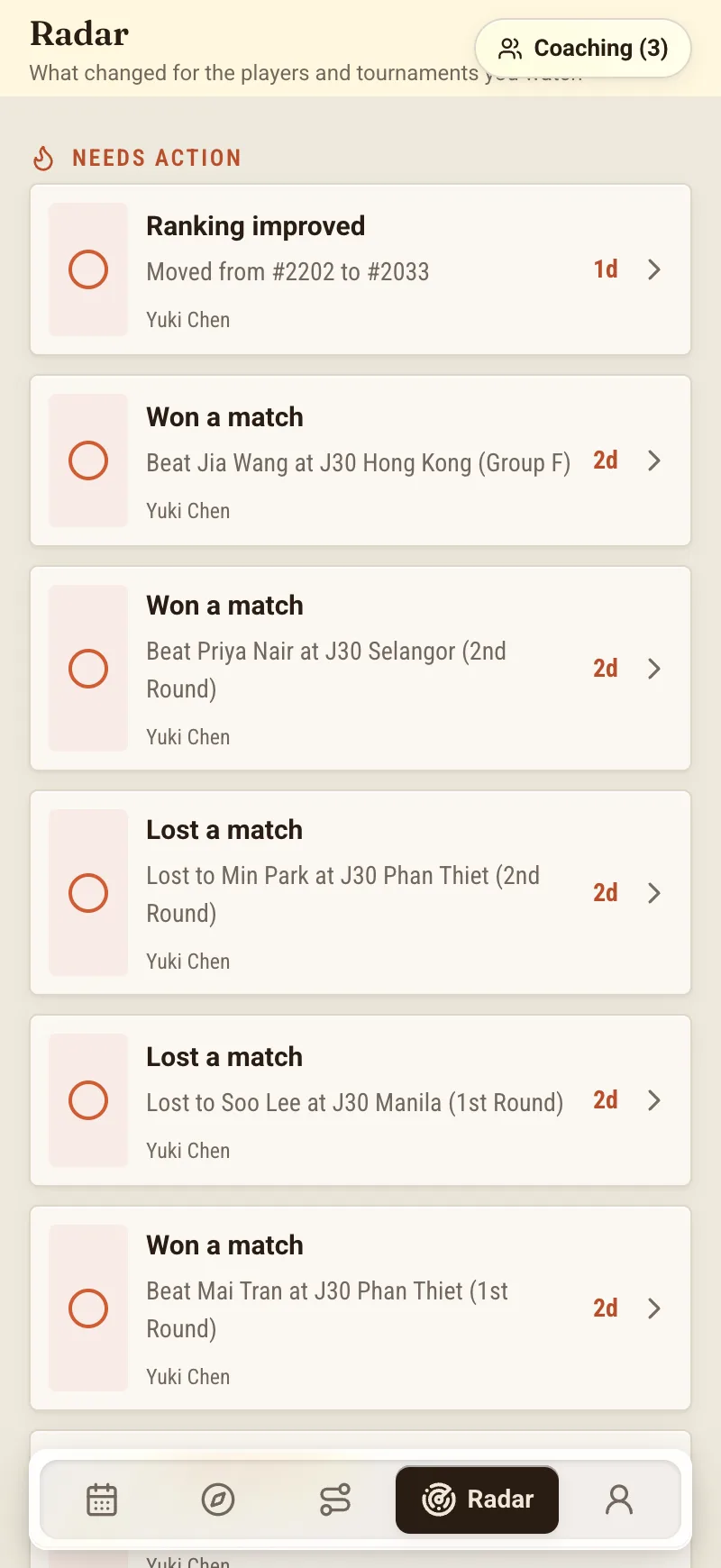
If you want the fuller walk-through of how the change feed is built and how to choose what it watches, that lives in Meet Radar: your daily change feed. This article is deliberately about the edges of the feature rather than the middle of it.
What Radar is not
Here is the part that matters most, stated as plainly as I can.
Radar is not live scores. It will not tell you that a set just went to a tiebreak or that a watched player is two games from the match. That is a different product entirely, and we do not pretend to offer it.
Radar is not live match streaming. There is no video, no court feed, nothing to watch in real time. It reads administrative changes — entries, deadlines, acceptance lists — not play.
Radar is not point-by-point tracking. It does not follow a match as it unfolds. Between one daily digest and the next, whole matches can happen and Radar will not narrate them. It reports the state of the entry and acceptance data, not the state of a scoreboard.
Radar is not a real-time, two-way federation integration. This is the one I most want to be honest about. Radar reads publicly available ITF and Tennis Europe data and reflects the changes it finds. It does not have a live pipe into the federations, and it does not act on your behalf — it never enters a player, never withdraws one, never pays a fee, never signs anyone in. Those are things you do on the official portal. NextPoint just watches and summarises.
None of these are features we are "working toward" or quietly ashamed of leaving out. They are a deliberate boundary. The moment a daily digest starts implying real-time coverage, it starts making promises the underlying data cannot keep.
Why "once a day" is a feature, not a shortcut
It would be easy to read "once a day" as a limitation we are apologising for. It isn't. It is a claim we can actually stand behind.
Because Radar reflects ITF and Tennis Europe data rather than owning it, the honest description of any figure it shows is what we last read from the source. Between digests, the real world keeps moving. A withdrawal can land an hour after Radar looked; an acceptance list can be re-published on the federation side while your digest still shows yesterday's cut. This is not a bug to engineer away — it is the nature of reading someone else's data on a schedule. So rather than dress a once-a-day reflection up as a live feed, we tell you plainly that it is a daily snapshot, and that the federation portal is the source of truth.
That has a practical consequence worth internalising: before you act on anything Radar surfaces — especially anything with money or a deadline attached — confirm it on the official ITF or Tennis Europe portal. Radar is there to make sure the right things land on your radar in the first place. It is not there to be the last word. A tool that says "here is what changed, go check the official page" is more useful, on a decision that costs real entry fees and travel, than one that implies its own figures are final when they cannot be.
There is a quieter reason too. A once-a-day rhythm is kinder to the way a tennis family actually lives. A live feed pinging all day trains you to keep looking, which is exactly the anxious loop a junior season does not need. One considered digest respects that you have a life outside the draw.
Reflections, not guarantees — and not endorsements
Two things follow from all of this, and they are the same two things that run through everything we build.
First, Radar deals in reflections, never guarantees. It tells you what appears to have changed based on the last read; it does not promise that a spot is secured, that a deadline is exactly when it displays, or that an acceptance position will hold. Where we show a figure, it is our reflection of a moving source, and the honest move is always to confirm it upstream. This is the same discipline behind our entry-chance work — if you want to see how far we take the "estimate, never a promise" principle, how NextPoint estimates entry chance, honestly is the long version.
Second, ITF and Tennis Europe are data sources, not affiliations or endorsements. Reading their public data does not make NextPoint a partner, and nothing Radar shows is the federations' official word — it is our reading of their published information, and it can lag. When the two disagree, the portal wins. Always.
The point of drawing the line
I have spent most of this article on what Radar cannot do, and I think that is the right emphasis. Anyone can slap "real-time" on a feature and let the word do the persuading. What is harder, and more useful, is telling you exactly where a tool stops so that the part that works, works completely.
So: Radar is a calm, once-a-day heads-up about deadlines, acceptance-list movement, and watched players entering, read from ITF and Tennis Europe and confirmed on their portals. It is not live scores, not streaming, not point-by-point, and not a real-time federation integration. Holding that line is not us underselling. It is the thing that lets you trust the digest for exactly what it is.
NextPoint is in early access while we get the details right. If a daily briefing that is honest about being a daily briefing sounds like the version you want, you can join the waitlist. We would rather tell you clearly what we watch than imply we watch everything.
About the author
Sofia Lindqvist is a sports scientist at NextPoint, where she works on player analytics and forecasting. She spends a lot of her time on the unfashionable question of what a feature should refuse to claim, on the belief that a tool you can trust at its edges is worth more than one that overstates its middle.