Product Notes
Where You See the Decision Score in the App
One Decision Score, out of 100, follows the tournament decision wherever you make it — a card on Explore, the full breakdown, the Today screen, every stop on a Path. Here is where it shows up and how to read it in each place.


I have written elsewhere about what a Decision Score measures and how the entry-chance estimate inside it is built. This piece is narrower and more practical. Assume you already trust the number. Where, in the app, do you actually meet it — and how should you read it differently depending on where you are standing?
That question matters more than it sounds. A tournament decision is not made in one place at one time. It starts as a maybe while someone scrolls a calendar. It gets weighed against three other weeks. It surfaces again the morning of a deadline, and once more when a coach opens a season plan and asks why this event is on it. If the number changed shape at every one of those moments — a percentage here, a label there, a different figure in the coach's view — you would not have a shared signal. You would have four arguments.
So we made a deliberate choice. It is one Decision Score, out of 100, with the same plain-language verdict and the same entry-chance estimate, everywhere the decision lives. What changes from screen to screen is how much of it you see, not what it says.
On an Explore card — the glance
Most people meet the score first on Explore, the surface for browsing events. Each tournament card carries its Decision Score right on the front: the number out of 100, and the one-line verdict that tells you what the number means in words — "Worth considering," "Strong option," "Probably skip this one." You are not meant to study it here. You are meant to glance, get a read, and keep scrolling or stop.
The card is deliberately thin. A number and a verdict, maybe the entry-chance range if we are confident enough to show it. That is the whole point of the glance: it lets you triage twenty events into the three worth a real look without opening any of them. The verdict is carrying more weight here than the number, because "worth considering" is a different instruction from "strong option," and you can act on the instruction without having to decide for yourself whether 64 out of 100 is good.
If a card shows no entry-chance figure, that is not a bug or a blank we forgot to fill. It means the field is too unsettled to put a responsible number on, and the absence is itself information — worth noticing before you build a fortnight around the event.
In the opportunity view — the breakdown
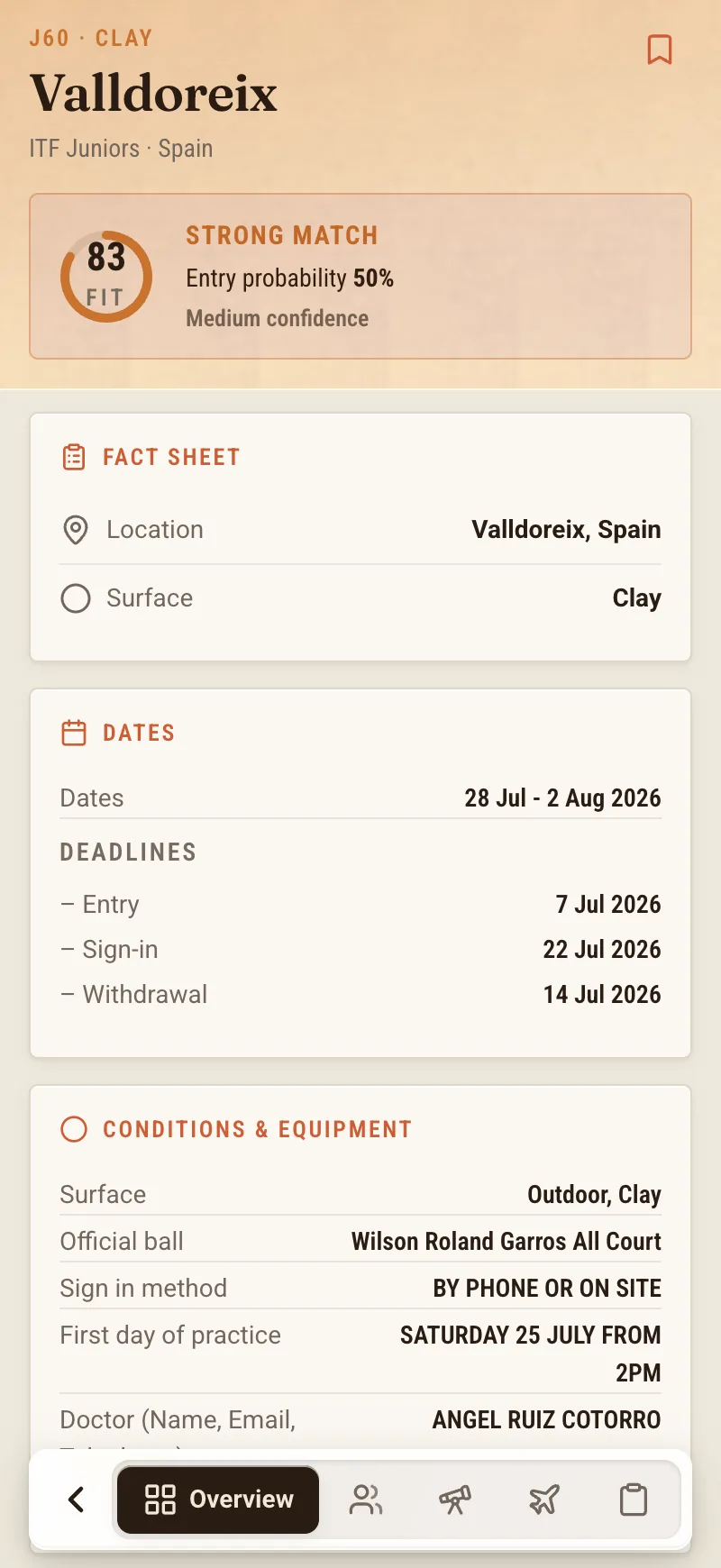
Tap the card and you get the event's fact sheet, or opportunity view — the same Decision Score, now opened up. This is where the single number comes apart into the factors that produced it: surface fit, whether the grade suits the player right now, the entry-chance estimate as a labelled range with its confidence note, the points on offer, the travel and cost, the schedule load against the weeks around it.
The glance told you what. The breakdown tells you why. If two events both scored in the seventies on their cards, this is where you find out that one earns it on surface and a light travel week while the other is riding a generous points opportunity you might not realistically reach. Those are different tournaments to say yes to, and the card alone cannot tell them apart.
This is also where the honesty machinery is on full display. The entry chance reads as a range — Est. 60–75% — with the "Est." on the label and a confidence note beside it, never a bare percentage pretending to be a fact. Where we forecast, we forecast in ranges. Where the data is too thin to support a responsible answer, the figure widens hard or disappears rather than printing false precision on top of not much. I have written about the reasoning behind that entry-chance estimate in more detail in How NextPoint Estimates Entry Chance — Honestly, and about the factors under the whole score in What a Decision Score Actually Measures.
On Today — the next move
The score does not only wait for you to go looking. On the Today screen it shows up inside the Next Best Move — the single suggestion the app surfaces when you open it, the one event it thinks is most worth your attention this week. The Decision Score rides along with that suggestion, the same number it would carry on its own Explore card.
The framing here is narrower on purpose. Today is not a browsing surface; it is a "if you do one thing, consider this" surface. So the score is doing the work of a recommendation you did not ask a question to receive. It is still the same signal — you can tap through to the full breakdown from here exactly as you would from Explore — but its job on Today is to catch a decision you might otherwise have missed until the deadline was uncomfortably close.
On a Path — the season in one line
The last place the score appears is the one families tend to discover last, and then rely on most. A Path is a season plan — a sequence of tournament stops laid out across the calendar. Every stop on that plan carries its Decision Score, which turns an abstract list of "events we are thinking about" into a readable strip of numbers and verdicts you can run your eye down.
This is where the score stops being about one tournament and starts being about a season. Seen in isolation, a 68 is fine. Seen as the fourth 68 in a row across four consecutive travel weeks, it tells a different story — one about accumulated load and cost that no single card could show you. Reading the scores down a Path is how the boring, decisive season-level details surface: the block that is too heavy, the month with nothing on the right surface, the stretch where entry chances are all soft at once.
Why it is the same number in all four places
Here is the part that took discipline, and it is worth saying plainly. It would have been easier to tune the score to its context — a punchier figure on the marketing-facing Explore card, a more cautious one in the coach's Path view. We did not, and the reason is the whole point of the feature.
A junior tennis decision usually has at least three people in it: a player, a parent, and a coach. They are rarely looking at the same screen at the same time. The player scrolls Explore on a phone. The parent opens the opportunity view to check what a week actually costs. The coach reads the Path. If each of them saw a number built to a different standard, the score would quietly become one more thing to disagree about — you would be back to arguing from three separate gut feelings, just with decimals attached.
Because it is one number with one meaning, the conversation starts from a shared place instead. The coach who sees a 58 with low entry confidence on a Path stop is looking at exactly what the player saw on the card. Nobody has to reconcile two figures before they can even begin to talk. The score does not settle the argument — the player still chooses, the coach still coaches — but everyone is arguing about the same thing, which is most of the battle.
What it still is not
Everywhere it appears, the Decision Score is the same kind of thing: an honest estimate, paired with a verdict and a confidence-labelled range. It is not a guarantee, and it is not a promise of acceptance. It does not enter you into events and it does not pay your fees — ITF and Tennis Europe results are the data sources the score reads from, not partners vouching for it. Seeing an 82 on four screens does not make it more certain than seeing it once. It just means four people can read the same honest guess without having to phone each other first.
NextPoint is in early access while we get details like this right — including the unglamorous work of making one number behave identically in four different places. If you would like your child's real rankings and entry lists turned into a Decision Score you can read the same way on a card, in a breakdown, on Today, and across a whole season, you can join the waitlist. We would rather show you less and be trusted than show you more and be wrong.
About the author
Sofia Lindqvist is a sports scientist at NextPoint, where she works on player analytics and forecasting. She spends most of her time on the unglamorous question of when a number is honest enough to show — and, lately, on making sure the same honest number reads the same way in every place a family might meet it.